
Oil and Gas Well Testing Process: From Wellhead to Oil and Gas Separation and Metering
After an oil and gas well has been drilled and enters the production testing stage, formation fluids such as oil, gas, and water flow from the wellbore into the surface system. When these fluids first come out of the wellhead, they are usually in a mixed state and cannot be directly sent to downstream storage or export systems. To understand the actual production capacity and fluid characteristics of the well, a set of surface well testing equipment is used to control, separate, and meter the wellstream.
A typical oil and gas well testing process can be illustrated as follows:
Wellhead →Choke Manifold→Test Separator→Metering System→Storage/Export
For wells with a relatively high gas production rate or testing conditions that require safe handling of produced gas, a flare system may also be included.
1.Oil and gas well testing starts at the wellhead.
Formation fluids returning through the wellbore enter the surface testing system from the wellhead. At this stage, the wellstream may contain crude oil, natural gas, water, and a certain amount of solid particles.
The wellhead equipment mainly provides the connection and control between the wellbore and the surface equipment, while also withstanding the pressure coming from the well.
Different oil and gas wells can have significantly different wellhead pressures, flow rates, and produced fluid compositions. Therefore, the downstream surface testing equipment needs to be configured according to the specific well conditions.
2.After leaving the wellhead, the wellstream usually enters the choke manifold first.
The main function of the choke manifold is to control the wellstream through the choke device, so that the flow rate and pressure entering the downstream testing equipment remain within a suitable range.
Simply put, the fluids coming from the wellhead cannot enter the separator directly without any control.
By using the choke manifold, the wellstream can be adjusted according to the testing requirements. It also allows operators to adjust the testing conditions based on changes in pressure, flow rate, and other operating parameters.
Therefore, in an oil and gas well testing process, the choke manifold is an important link between the wellhead and the downstream processing equipment.
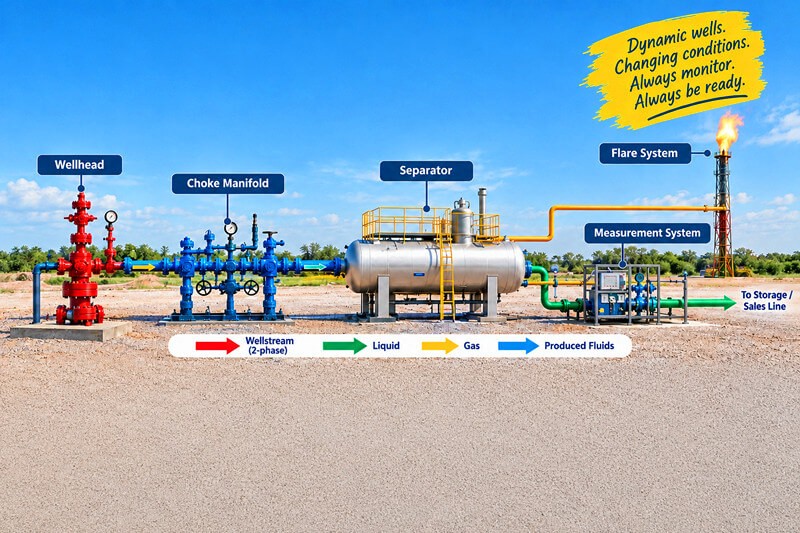
3.Test Separator: Separating the Mixed Wellstream
After pressure and flow control through the choke manifold, the wellstream enters the test separator, which is one of the core pieces of equipment in a surface well testing system.
The fluids coming from the wellhead are usually a mixture of oil, gas, and water. Inside the separator, gas and liquid can be separated, or oil, gas, and water can be further separated into three phases, based on the differences in density between the fluids and the available separation space and residence time.
Depending on the testing requirements, different types of test separators can be configured, such as: two-phase test separators, mainly used for gas-liquid separation; and three-phase test separators, used for oil, gas, and water separation.
After separation, the gas leaves through the gas outlet of the separator, while the liquids enter the downstream system through the liquid outlet. If separate oil and water production rates need to be determined, a three-phase separation process is generally required.
4.Metering System: Determining How Much the Well Actually Produces
After separation, the wellstream enters another important stage of oil and gas well testing — metering.
The purpose of testing is not only to separate oil, gas, and water, but more importantly, to determine how much oil, gas, and water the well is actually producing. Therefore, different phases need to be metered according to the testing program.
Common testing data include oil flow rate, gas flow rate, water flow rate, pressure, and temperature.
These data help engineers understand the current production performance of the well and provide basic data for subsequent production planning and reservoir evaluation.
Therefore, the test separator and metering system are closely connected in a surface well testing system.
5.Flare System: Safe Handling of Gas Produced During Testing
At some oil and gas well testing sites, the separated natural gas may not be suitable for direct entry into a sales or gas transmission system. In such cases, a flare system may be configured according to the site conditions. The gas leaving the separator can be transported through pipelines to the flare system for controlled combustion.
The function of the flare system is not to participate in oil and gas separation, but to provide safe and controlled handling of combustible gas produced during the testing process.
Therefore, in a complete surface well testing system, the flare system is generally considered part of the safety handling stage.
6.After Testing, the Fluids Enter the Storage or Export System
After separation and metering, the oil, water, and gas are directed to their respective downstream systems.
Depending on the site conditions, the liquids may enter storage tanks or other processing facilities, while the natural gas may enter a sales pipeline, gas processing system, or be handled according to the site-specific testing plan.
At this point, a complete surface oil and gas well testing process is essentially completed.