
What Is the Core Difference Between Two-Phase and Three-Phase Separators?
In oil and gas fields, natural gas processing and petrochemical production, common separators can be divided into two-phase gas-liquid separators and three-phase separators according to the different media that need to be separated.
Although the two types of separators have many similarities in appearance and basic structure, they are different in terms of the process media they handle, separation objectives, internal structure and liquid level control methods.
What Is the Core Difference Between Two-Phase and Three-Phase Separators?
| Comparison Item | Two-Phase Gas-Liquid Separator | Three-Phase Separator |
| Main Separation Objects | Gas + Liquid | Gas + Oil + Water |
| Main Separation Principle | Gas-liquid density difference, gravity settling and demisting | Gas-liquid separation + oil-water gravity separation |
| Internal Liquid Phase Area | Usually one liquid phase area | Usually requires separate oil and water phases |
| Level Control | Mainly controls the liquid level | Usually requires interface level control |
| Typical Applications | Wellhead gas-liquid separation, natural gas processing, gas dehydration and liquid removal, etc. | Crude oil processing, oil-water separation, oil and gas field production processing, et |
Where Are Two-Phase and Three-Phase Separators Used?
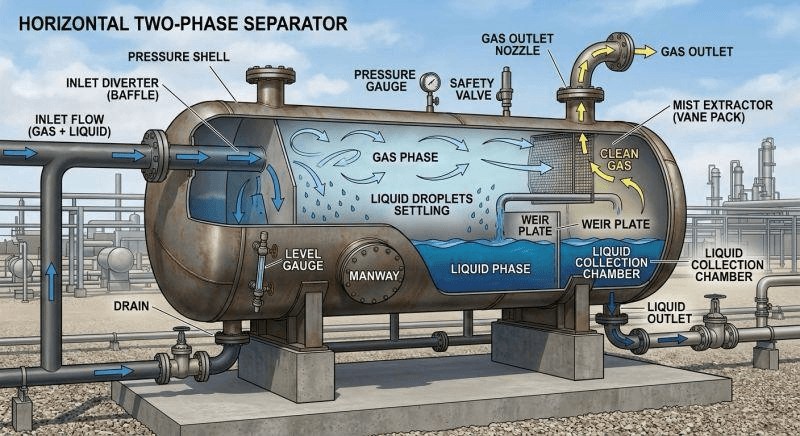
Two-phase gas-liquid separators are mainly used in process applications where gas and liquid need to be separated, such as:
Oil and gas field wellhead production systems
Well testing equipment
Natural gas processing systems
Natural gas liquid removal systems
Oil and gas gathering systems
Compressor inlet gas-liquid separation
Petrochemical production units
If the process only requires gas to be separated from liquid, without the need to further separate oil and water from the liquid phase, a two-phase separator is usually sufficient.
Three-phase separators are more commonly used in applications where gas, oil and water need to be processed simultaneously, such as:
Crude oil processing systems
Oil and gas field surface gathering systems
Early Production Facilities
Wellhead production processing systems
Oil-gas-water three-phase separation units
Crude oil dehydration and processing systems
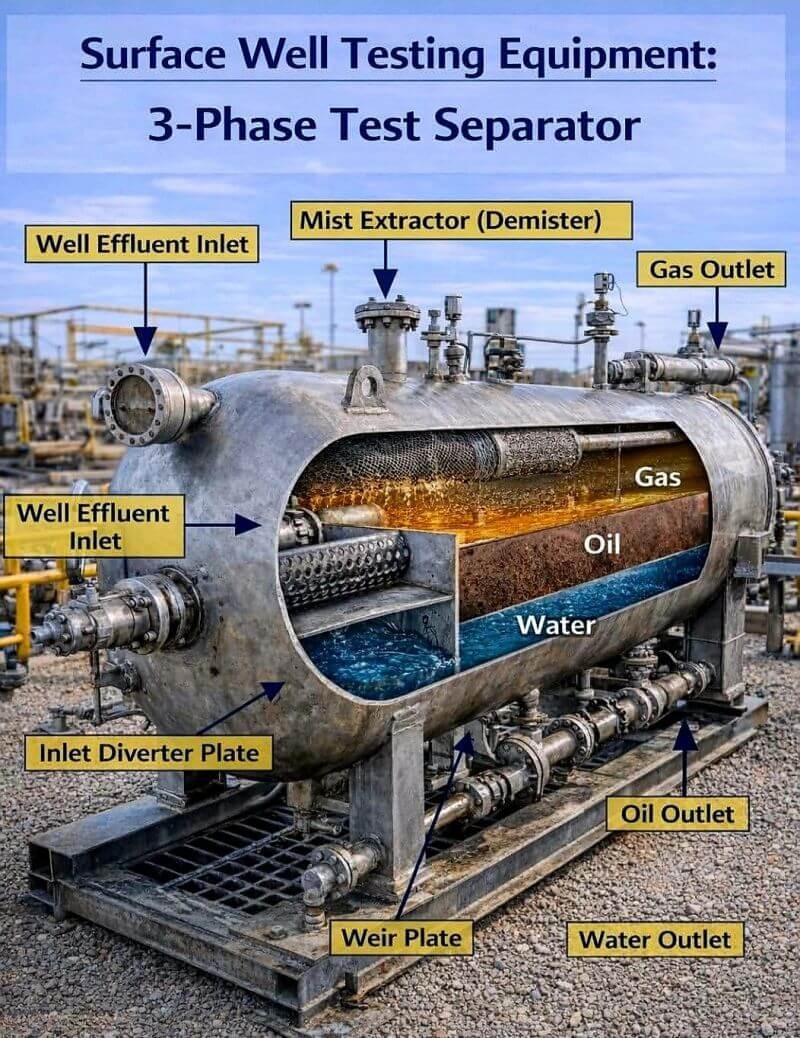
Especially in oil and gas field production, when the produced fluid contains significant amounts of natural gas, crude oil and water, a three-phase separator is required to further separate these three phases.
How to Choose Between a Two-Phase and a Three-Phase Separator?
In actual projects, a three-phase separator is not necessarily better than a two-phase separator. The appropriate type should be selected according to the specific process requirements and composition of the media.
If the upstream fluid mainly needs to undergo gas-liquid separation and the liquid does not need to be further separated into oil and water, a two-phase gas-liquid separator can be used. If the upstream fluid contains gas, oil and water, and the process requires the oil and water phases to be obtained separately, a three-phase separator should be considered.
Therefore, separator selection generally requires comprehensive consideration of the following parameters: media composition, gas and liquid flow rates, water and oil content, operating pressure, operating temperature, gas and liquid densities, oil and water densities, and the required separation efficiency.
The separator dimensions, internal structure, inlet device, demister and level control system also need to be designed according to the specific operating conditions.