






In many oilfield projects, RFQs for oil and gas separators are issued at an early stage, often when production data is still evolving. From HC’s experience working with operators and EPC contractors, the efficiency of the quotation and technical evaluation process depends largely on whether the right information is prepared and shared upfront. Clear technical context at the RFQ stage allows engineering discussions to start earlier and helps avoid unnecessary design revisions later in the project.
What production information should be prepared in advance?
Before issuing an RFQ, it is helpful to compile realistic estimates of production flow rates, operating pressure and temperature, gas-oil ratio, and water cut. Even when these values are preliminary, indicating expected ranges rather than fixed numbers provides a more useful basis for engineering evaluation. For oil well site applications, it is particularly helpful to note whether production is expected to fluctuate significantly during start-up or early production.
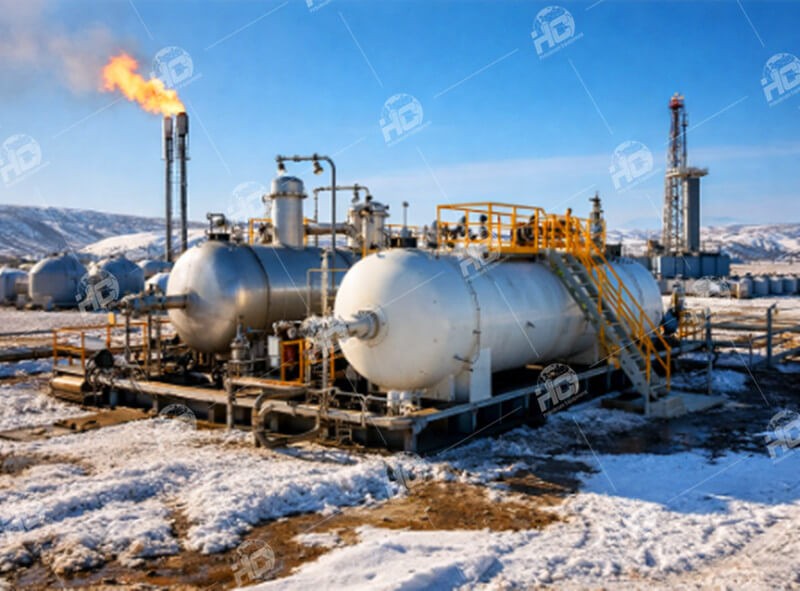
Why does flow variation matter more than a single design point?
In actual operation, separators are rarely exposed to constant conditions. Based on HC’s project experience, many operational issues originate from designs that perform well at nominal flow but struggle during turndown or short-term surges. Sharing information on minimum, normal, and peak flow conditions allows the separator to be designed for stable performance across its real operating envelope rather than around a single assumed condition.
Should a two phase or three phase separator be specified in the RFQ?
This is one of the most common points of confusion at the RFQ stage. From a practical perspective, the decision should be based on how water is expected to behave at the oil well site rather than on equipment cost alone.
If free water is produced and needs to be separated, handled, or controlled at the well site, a three phase separator is generally the more appropriate choice. This is often the case during early production or in fields where water cut is expected to increase over time. In contrast, if water production is minimal, intermittent, or handled downstream in a centralized facility, a two phase separator may be sufficient for initial separation duties.
When issuing an RFQ, it is helpful to clearly state whether free water is expected, whether water cut is likely to change, and how separated water will be managed downstream. Even if the final decision between two phase and three phase separation has not been made, sharing this information allows the engineering discussion to move forward more efficiently.
How should sand production be described?
If sand production is expected, even intermittently, this information should be clearly stated in the RFQ. Sand content influences internal arrangement, vessel layout, and maintenance planning. HC has seen projects where the absence of sand-related information at the RFQ stage led to design adjustments after commissioning. Early disclosure allows solids handling to be addressed as part of the original design rather than as a corrective measure.
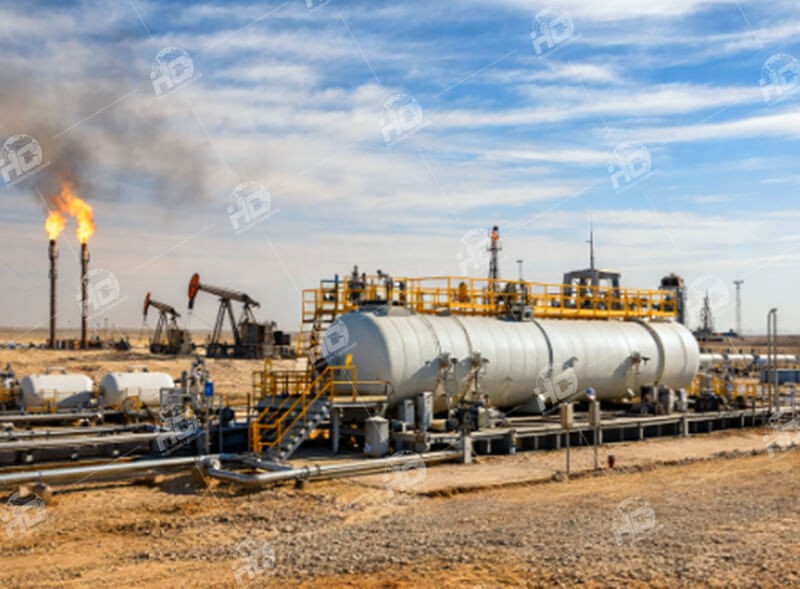
What should be clarified regarding separation requirements?
It is useful to describe how separated oil, gas, and water will be handled downstream. For example, whether water must meet certain quality limits before discharge or reinjection, or whether minor water carryover in oil is acceptable. These requirements directly affect separator configuration and control philosophy and help ensure the separator supports the overall process rather than operating in isolation.
How do site conditions affect the RFQ information?
Site-specific constraints such as ambient temperature, available plot space, accessibility for maintenance, and utility limitations should be included where possible. From HC’s experience in remote and cold-region oilfields, these factors often have a greater impact on equipment configuration than nominal process data.
An effective RFQ is not simply a request for pricing, but the starting point of an engineering conversation. Experience from HC’s oilfield projects shows that when key production information—including water behavior and phase separation expectations—is shared early, the selection between three phase and two phase separators becomes clearer, and project execution proceeds with fewer revisions and delays.
-
2026 / 08 / 13
 Dual Pot Sand Filter Designed and Manufactured for an Oman Oil & Gas Project
 -
2026 / 08 / 07
 Three Vertical Three-Phase Separators Completed for Oil & Gas Project by HC Petroleum
 -
2026 / 07 / 24
 Two 1440 PSI Three-Phase Separators Completed for Nigeria Oil & Gas Project
- +86 158 6190 3617
